
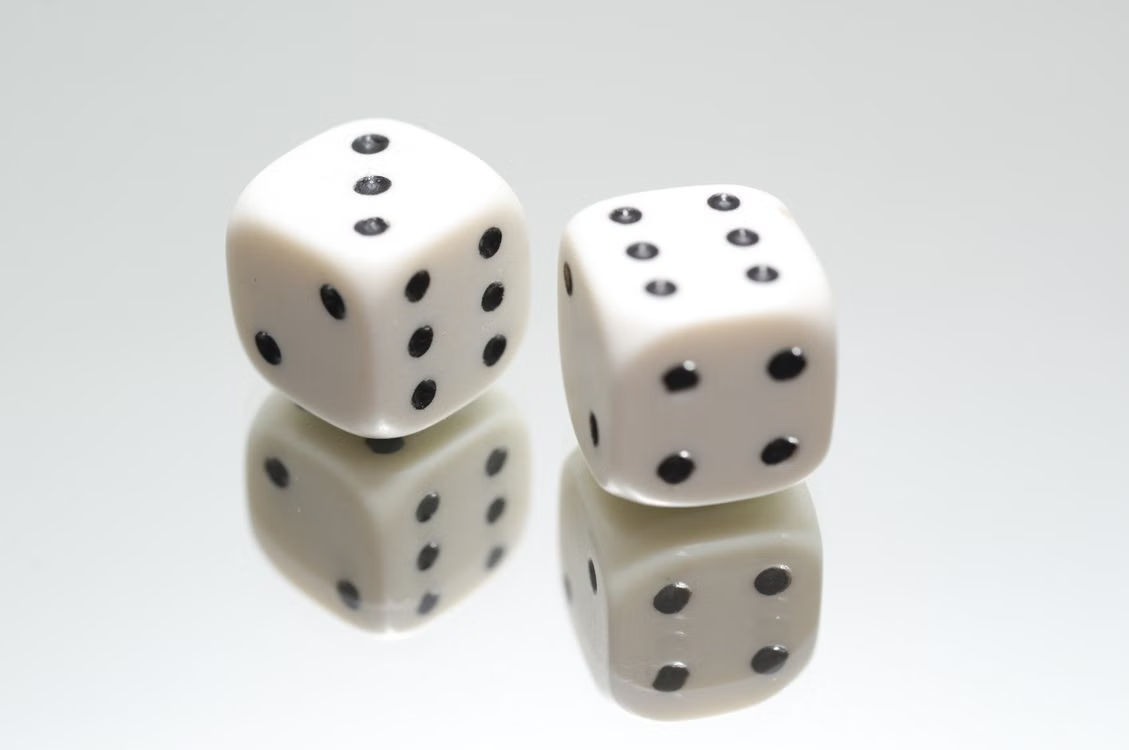
Pick up a standard six sided die and turn it over. Whatever face sits on top, the one underneath completes a sum of seven. Flip a one to find six, a two for five. Dice makers have followed this habit for centuries, and almost nobody notices. The rule matters wherever dice are rolled in public, from a kitchen table to a filmed studio. In live game shows, such as the dice tables streamed through the casino spinfin lobby, cameras zoom in on the cubes so viewers can check the result themselves. A predictable layout makes that check quick.
Why the Numbers Are Paired This Way
The pairing is not magic. It is a balancing trick. The faces carry 21 pips in total, and pairing them to seven keeps the weight spread evenly around the center.
Pips are tiny drilled holes, so a face with six of them is slightly lighter than a face with one. Putting them on opposite sides cancels most of that imbalance. The method is simple to follow on any die.
- Find the face showing one and look straight across it.
- Confirm the opposite face shows six.
- Repeat for two and five, then three and four.
Two Dice, Two Mirror Images
The seven rule still leaves a choice. Place one, two, and three around a corner, and you can run them clockwise or anticlockwise. That gives two versions of the same die, mirror images that cannot be rotated into each other.
Most Western dice are made in a counterclockwise pattern, though plenty of exceptions exist. Hobby board game makers sometimes mix both, and a handful of collectors seek out the rare ones on purpose. Casual players never see the difference. A tabletop role player does only if a friend swaps in an old die and the one, two, and three suddenly turn the wrong way around, which feels oddly like writing with the wrong hand.
What Seven Does to the Odds
Opposite faces summing to seven also shapes how people think about probability. Each face of a fair die lands with a chance of one in six, so the pairing changes nothing about a single throw. It does explain a famous pattern with two dice.
Seven is the most common total of a pair, because six of the 36 possible combinations produce it. Two and twelve appear only once each, so they are far rarer.
How Often Each Total Appears
Counting the combinations makes the pattern plain. Here is the count for several totals from two fair dice.
| Total | Combinations out of 36 | Chance |
| 2 or 12 | 1 | about 2.8 percent |
| 4 or 10 | 3 | about 8.3 percent |
| 6 or 8 | 5 | about 13.9 percent |
| 7 | 6 | about 16.7 percent |
The table shows why board game designers like seven as a pivot. Settlers of Catan, for example, marks the six and eight with red numbers because those totals are the next most frequent after seven.
Where the Rule Helps in Play
Knowing the opposite face is a small trick for magicians and teachers. If a die lands on a table and you glimpse only the top, you know the bottom without lifting it. Spotting a die that breaks the rule also reveals a novelty or trick cube immediately.
Teachers use the same fact to explain subtraction. Ask a child what hides underneath a four, and they practice seven minus four without noticing it is homework.
A Small Rule Worth Checking Yourself
Because this fact is so familiar, it is often repeated without checking. Take any die from a family game box and test it. A genuine standard die obeys the rule every time, and a die that does not is usually a puzzle cube or a promotional item.
Try it with a handful of dice from different sets, say a school maths kit, an old backgammon box, and a cheap party pack. Chances are all of them agree, which is a quiet sign of how strongly manufacturers stick to convention. A rule this old survives because it is practical, cheap to follow, and easy to verify. It costs nothing and takes only roughly ten very quick seconds at any table. Next time dice hit the table, look at the face you cannot see and subtract from seven. The answer is already there.
