
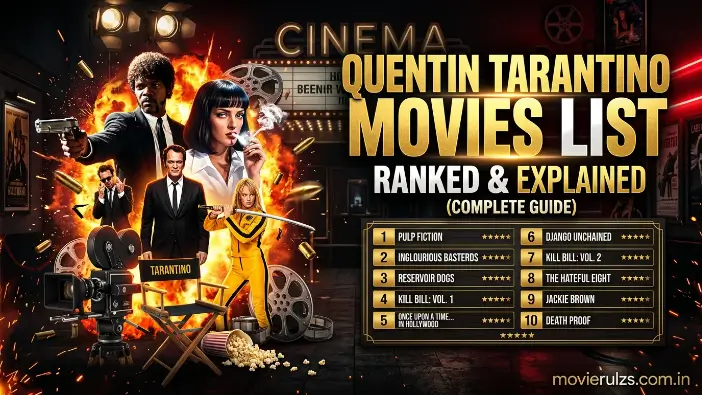
Welcome to movie rulzs. Quentin Tarantino is one of the most influential filmmakers in modern cinema, known for his bold storytelling and unforgettable characters. His films are a mix of crime, drama, action, and sharp dialogue that keep audiences fully engaged. In this guide, we will explore Quentin Tarantino movies in detail and understand why they are considered iconic in Hollywood.
From his early breakthrough to modern classics, his work has uniquely shaped global cinema. His Tarantino filmography is filled with creativity, non-linear storytelling, and powerful performances that make every film stand out. This article will help you explore his journey in a simple and structured way.
If you are someone who loves intense storytelling and unexpected twists, then this guide is for you. Imagine watching films where every scene feels unpredictable and powerful, yet deeply meaningful. That is the magic of the best Tarantino films, where even dialogue becomes a cinematic experience that hooks you from the very first moment.
Complete Quentin Tarantino Movies List (Chronological Order)
Quentin Tarantino’s movie journey shows how a filmmaker can change modern cinema with bold ideas and unique storytelling. His Quentin Tarantino movies are known for strong characters, sharp dialogue, and unforgettable scenes that stay in the audience’s memory. From early crime stories to large-scale modern films, his work keeps growing in impact. This list shows how his style developed over time, starting small and becoming globally famous. Each film adds something new to his Tarantino filmography and reflects his creative vision in simple yet powerful storytelling.
Early Career Breakthrough
Tarantino’s early career started with raw, low-budget films that quickly gained cult status. Reservoir Dogs (1992) introduced his signature style of tension-driven storytelling and sharp dialogue. It focused on a failed robbery and built suspense mostly through conversations instead of action.
Then came Pulp Fiction (1994), which became a global phenomenon. Its non-linear structure and iconic characters made it one of the most influential films in cinema history and established Tarantino as a major Hollywood director.
- Reservoir Dogs (1992): A crime thriller that uses dialogue and tension instead of action-heavy scenes, creating psychological pressure among characters.
- Pulp Fiction (1994): A multi-story crime film with non-linear storytelling, dark humor, and unforgettable pop culture moments.
Establishing His Signature Style
In this phase, Tarantino developed a more refined and artistic approach to filmmaking. Jackie Brown (1997) showed a slower, more character-focused story compared to his earlier works. It highlighted emotional depth and realistic crime drama elements.
The Kill Bill series (Vol. 1 and Vol. 2) took his style in a completely different direction, combining martial arts action with revenge storytelling. These films became visual masterpieces known for their creativity and strong female leads.
- Jackie Brown (1997): A grounded crime drama focusing on character emotions, betrayal, and realistic storytelling.
- Kill Bill Vol. 1 (2003): A stylized revenge film with martial arts action and highly visual fight sequences.
- Kill Bill Vol. 2 (2004): A slower emotional continuation focusing on story resolution and deeper character arcs.
Modern Era Masterpieces
Tarantino’s modern films reflect his maturity as a filmmaker with stronger themes and a bigger storytelling scope. Inglourious Basterds (2009) and Django Unchained (2012) reimagined history in bold and creative ways. These films became both critically and commercially successful.
Later films like The Hateful Eight (2015) and Once Upon a Time in Hollywood (2019) focused more on dialogue, atmosphere, and nostalgia. They show his evolution into a master of cinematic storytelling.
- Death Proof (2007): A grindhouse-style thriller focused on car chases and suspense-driven storytelling.
- Inglourious Basterds (2009): An alternate history war film with strong dialogue and intense character moments.
- Django Unchained (2012): A revenge western dealing with slavery and justice with emotional depth.
- The Hateful Eight (2015): A slow-burning thriller set in one location with heavy dialogue and tension.
- Once Upon a Time in Hollywood (2019): A nostalgic tribute to Hollywood’s golden era with layered storytelling.
Read Also: movies out right now
Quentin Tarantino Movies Ranked (Best to Worst)
Quentin Tarantino is known for creating some of the most iconic films in Hollywood history, and ranking his Quentin Tarantino movies is not easy because each film has its own unique style and impact. From intense crime dramas to stylish action and historical reimaginings, his Tarantino filmography covers a wide range of storytelling. However, based on popularity, critical success, and cultural influence, his films can be grouped into top, middle, and least popular categories. This ranking helps understand his creative journey and cinematic evolution.
Top 5 Greatest Tarantino Films
Quentin Tarantino’s top 5 films are considered the strongest and most influential works in his career. Quentin Tarantino movies like Pulp Fiction stand out for their non-linear storytelling and cultural impact. Inglourious Basterds redefined war cinema with alternate history elements, while Django Unchained delivered a powerful mix of revenge and emotional storytelling.
Reservoir Dogs introduced his raw crime-driven style, and Kill Bill Vol. 1 showcased highly stylized martial arts action. Together, these films represent the peak of Tarantino’s best films and highlight his creative storytelling power.
- Pulp Fiction: A groundbreaking crime film with multiple storylines and iconic dialogue that reshaped modern cinema.
- Inglourious Basterds: A war film with alternate history, strong characters, and intense suspense.
- Django Unchained: A revenge western exploring slavery, justice, and emotional depth.
- Reservoir Dogs: A crime thriller focused on betrayal, tension, and dialogue-heavy storytelling.
- Kill Bill Vol. 1: A stylish martial arts film with strong visual action sequences.
Middle Tier Films
Middle-tier films by Tarantino are strong but not as globally dominant as his top works. Jackie Brown is a slow-paced crime drama that focuses on character development and realism. It offers a more grounded storytelling style compared to his other films.
Once Upon a Time in Hollywood is a nostalgic tribute to old Hollywood, blending fiction with real historical elements. Kill Bill Vol. 2 continues the revenge story with more emotional depth and dialogue-driven scenes, making it more reflective than action-heavy.
- Jackie Brown: A realistic crime drama focused on emotion, betrayal, and character depth.
- Once Upon a Time in Hollywood: A nostalgic film capturing Hollywood’s golden era with soft storytelling.
- Kill Bill Vol. 2: A slower, emotional continuation of the revenge story with a strong dialogue focus.
Least Popular but Unique Films
These films may not be as popular as his biggest hits, but they are highly creative and experimental. Death Proof is a grindhouse-style thriller centered on car chases and suspense-driven storytelling. It focuses more on tension than traditional narrative structure.
The Hateful Eight is a slow-burning western set in a single location, where dialogue and character interaction build the entire tension. Both films highlight Tarantino’s experimental side and his willingness to explore different storytelling styles.
- Death Proof: A cult thriller focused on high-speed car chases and suspense-building techniques.
- The Hateful Eight: A dialogue-heavy western that builds tension in a confined snowy setting.
Quentin Tarantino’s Filmmaking Style Explained
Quentin Tarantino is known for a very unique and bold filmmaking style that has changed modern cinema. His Quentin Tarantino movies are built on strong storytelling, sharp dialogue, and creative visuals that feel different from traditional films. He mixes crime, drama, and action in a way that keeps viewers fully engaged. His Tarantino filmography shows how he uses non-linear storytelling, stylized violence, and cultural references to create unforgettable scenes. Every film reflects his strong creative identity and makes his work instantly recognizable in Hollywood.
Nonlinear Storytelling Technique
Tarantino often tells stories in a non-chronological order, which means events are shown in a mixed timeline. This technique creates curiosity and keeps the audience engaged because they slowly piece the story together. It is one of the most important parts of his Tarantino-style filmmaking.
This approach makes even simple plots feel complex and interesting. Films like Pulp Fiction are perfect examples where multiple stories connect in unexpected ways. This method gives his movies a unique rhythm and makes viewers pay close attention to every scene.
Dialogue-Driven Screenwriting
One of Tarantino’s strongest skills is writing powerful and engaging dialogue. His characters often talk in long conversations that reveal personality, emotions, and hidden meanings. This is a key feature of Quentin Tarantino’s movies and makes his storytelling very different from action-heavy films.
His dialogue often builds tension without action scenes, making even quiet moments feel intense. In many of the best Tarantino films, conversations are more important than visuals, as they move the story forward and develop deep character connections.
Stylized Violence and Cinematic Aesthetics
Tarantino uses violence in a highly stylized and artistic way instead of showing it realistically. His scenes are carefully designed to look visually striking, often mixing exaggeration with creativity. This makes his films feel like a blend of art and entertainment.
His Tarantino filmography shows that violence is not just for shock value but also for storytelling. Movies like Kill Bill and Django Unchained use action scenes to highlight emotion, revenge, and character motivation.
Music and Pop Culture Influence
Music plays a very important role in Tarantino’s films. He carefully selects songs that match the mood of each scene, making them more powerful and memorable. This technique is a major part of his cinematic storytelling style.
He also uses pop culture references throughout his movies, which makes his work feel modern and relatable. These elements help connect audiences emotionally while giving his films a unique identity that stands out in Hollywood cinema.
Beginner’s Guide – Which Tarantino Movie to Watch First?
Starting with Quentin Tarantino’s movies can feel confusing for new viewers because his style is very different from that of other films. His Quentin Tarantino movies include crime, action, and drama mixed with non-linear storytelling and strong dialogue. This makes his films unique but sometimes difficult for beginners to follow. That is why choosing the right first movie is important. Films like Pulp Fiction and Django Unchained are great starting points because they are simple, engaging, and still show his signature filmmaking style clearly.
Best Starting Films for New Viewers
The best starting films for beginners are those that clearly show Tarantino’s storytelling style without being too complex. Pulp Fiction is the most recommended because it entertainingly introduces non-linear storytelling. It has multiple connected stories, strong dialogue, and memorable characters that define his filmmaking approach.
Another great option is Django Unchained, which is easier to follow and more emotionally direct. It combines action, story, and strong character motivation, making it ideal for first-time viewers of the best Tarantino films.
- Pulp Fiction: A crime film with multiple timelines, iconic dialogue, and interconnected stories that define Tarantino’s style.
- Django Unchained: A revenge western with clear storytelling, emotional depth, and powerful action scenes.
Recommendations Based on Interest
Tarantino’s films can be chosen based on personal interest because each genre offers a different experience. Action lovers usually enjoy fast-paced scenes, crime drama fans prefer dialogue-heavy storytelling, and history fans enjoy alternate historical narratives.
This approach helps beginners enjoy Tarantino-style filmmaking in a simple and personalized way. Choosing the right film based on taste makes the viewing experience more enjoyable and less confusing.
- Action lovers: Kill Bill Vol. 1 offers martial arts action, stylish fight scenes, and high-energy storytelling.
- Crime drama fans: Pulp Fiction is ideal for dialogue, tension, and complex character interactions.
- History-based film fans: Inglourious Basterds presents alternate war history with suspense and strong narrative impact.
Themes Common in Quentin Tarantino Movies
Quentin Tarantino’s movies are known for strong and repeated themes that make his storytelling unique and powerful. His Quentin Tarantino movies often focus on revenge, crime, and complex human behavior shown through intense dialogue and emotional scenes. He also uses Tarantino’s filmography style of storytelling, where characters are not simple heroes or villains but morally mixed personalities. His films often explore different timelines, strong emotions, and unexpected twists. These themes help his movies stand out and create a deep impact on audiences who enjoy creative and bold cinema experiences.
- Revenge Narratives: Revenge is one of the most common themes in his films, where characters are driven by personal justice and emotional pain. Movies like Kill Bill show how revenge becomes a journey of transformation and strength. It adds intensity and emotional depth to the story.
- Crime and Morality: Many of the best Tarantino films explore the world of crime, where characters live in morally grey areas. Instead of clear good or bad roles, characters make complex choices that challenge traditional ideas of right and wrong.
- Alternate History Storytelling: Tarantino often rewrites historical events in creative ways. Films like Inglourious Basterds show fictional outcomes of real history, making stories more engaging and unpredictable while keeping viewers emotionally invested.
- Strong Female and Anti-Hero Characters: His films often feature powerful female leads and anti-heroes who break traditional stereotypes. These characters are strong, flawed, and independent, making Tarantino’s style of filmmaking more dynamic and modern.
Common Mistakes While Watching Tarantino Movies
Many viewers make simple mistakes while watching Quentin Tarantino movies because his style is very different from normal Hollywood films. His Quentin Tarantino movies often use non-linear storytelling, deep dialogue, and hidden meanings that require attention. People who expect a simple, straight story may feel confused. In Tarantino’s filmography, every scene has a purpose, even small conversations. Understanding his style is important to enjoy the full experience. These common mistakes reduce enjoyment and stop viewers from appreciating the creativity, depth, and storytelling power behind his unique cinematic approach.
- Expecting Linear Storytelling: Many viewers expect a normal beginning-to-end story, but Tarantino often jumps between timelines. This non-linear style is part of his best Tarantino films and makes the story more interesting, but also requires attention to understand properly.
- Missing Dialogue Symbolism: His dialogue is not just conversation; it often carries hidden meaning, emotions, and character development. Ignoring these details means missing important parts of the story that connect scenes and explain character motivations in Tarantino-style filmmaking.
- Watching Without Context: Some films reference history, pop culture, or earlier events. Without understanding context, viewers may miss the deeper meaning. Knowing background information helps fully enjoy the creativity and layered storytelling in his movies.
Expert Tips to Enjoy Quentin Tarantino Movies
To truly enjoy Quentin Tarantino’s movies, viewers need to watch them with attention and patience. His Quentin Tarantino movies are not simple stories; they are layered with meaning, strong dialogue, and hidden references. Many details in Tarantino’s filmography are easy to miss in the first viewing. His storytelling style is creative, non-linear, and full of cultural elements. That is why understanding how to watch his films properly can greatly improve the experience. These expert tips help viewers enjoy his movies in a deeper and more meaningful way.
- Watch More Than Once: Many of the best Tarantino films reveal new details on second or third viewing. The first watch helps you understand the story, while repeat viewing helps you notice hidden clues, character depth, and small connections between scenes that were missed earlier.
- Focus on Dialogue: Dialogue is one of the strongest parts of Tarantino’s style of filmmaking. Conversations often carry hidden meanings, emotional tension, and story progression. Paying attention to dialogue helps you understand characters better and enjoy the film more deeply.
- Understand References and Influences: Tarantino often uses references from old movies, pop culture, and history. Knowing these influences helps viewers understand deeper meanings and enjoy the creativity behind each scene. It also makes the storytelling richer and more meaningful.
Frequently Asked Questions (FAQs)
Why are Quentin Tarantino’s movies considered different from other Hollywood films?
They use a mix of storytelling styles, strong character focus, and creative dialogue that breaks traditional film structure and keeps viewers engaged.
Do Quentin Tarantino movies need to be watched in order?
No, most of his films are independent stories, so you can watch them in any order without missing the main storyline.
What makes Tarantino’s dialogue so important in his films?
His dialogue often reveals character personality, builds tension, and moves the story forward without relying heavily on action scenes.
Are Quentin Tarantino’s movies suitable for beginners?
Yes, but beginners should start with simpler films like Pulp Fiction or Django Unchained to better understand his style.
Why do Tarantino movies include so many pop culture references?
He uses them to add realism, humor, and deeper meaning, making his films feel more connected to real-world culture and history.
Conclusion
Quentin Tarantino’s movies are a unique mix of storytelling, style, and creativity. His Quentin Tarantino movies are known for strong dialogue, non-linear structure, and unforgettable characters. Each film offers something different, from crime drama to action and historical fiction. His Tarantino filmography shows how he changed modern cinema with bold ideas and powerful direction. Understanding his style helps viewers enjoy his work in a deeper way and appreciate the details hidden in every scene.
Overall, Tarantino’s films are not just entertainment but a full cinematic experience. They challenge viewers to think, observe, and connect different story elements. Whether you are a beginner or a fan, his movies always leave a strong impact and lasting impression.
