
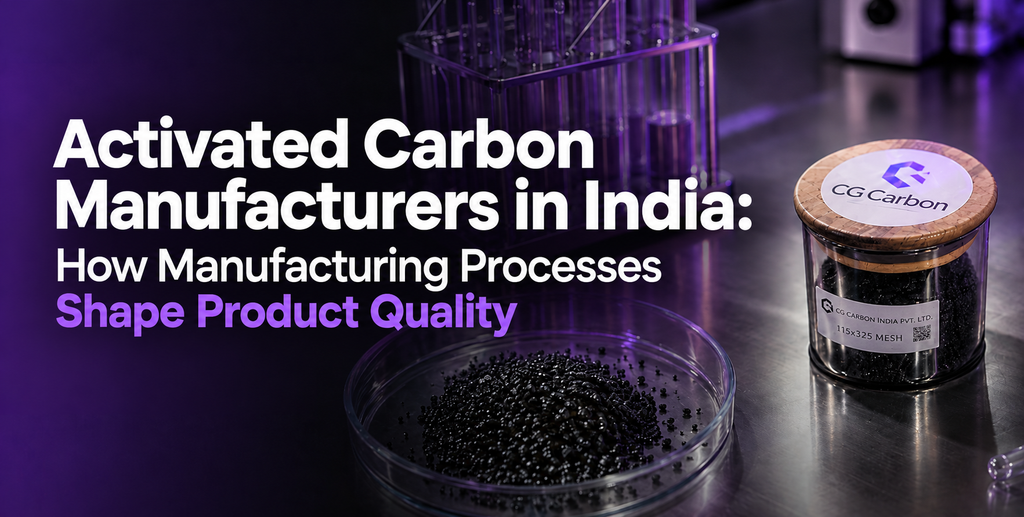
Activated carbon is used in industries where purification, adsorption and process efficiency are essential. From recovering gold in mining operations to treating industrial water and controlling gaseous contaminants, its performance depends on more than the presence of a porous carbon material.
The manufacturing process plays a major role in determining the properties of the final product. For businesses researching activated carbon manufacturers in India, understanding how activated carbon is produced can help them evaluate product quality, compare specifications and identify a suitable manufacturing partner.
How Is Activated Carbon Manufactured?
Activated carbon manufacturing involves several stages that influence the material’s final properties. Although the exact process varies according to the raw material and production method, the main objective is to develop a pore structure suitable for adsorption.
1. Raw Material Selection
The manufacturing process begins with selecting a suitable carbon-rich raw material. Common sources include coconut shells, coal and wood. Each source has different physical and chemical characteristics that influence the properties of the resulting activated carbon.
Coconut shell charcoal is widely used for producing activated carbon with a hard structure and a well-developed microporous network. These characteristics can be valuable in applications such as gold recovery and certain water and gas treatment processes.
However, the raw material alone does not determine the finished product’s quality. Its characteristics must be considered alongside the activation method and the intended application.
2. Carbonisation
Carbonisation involves heating the raw material under controlled conditions to produce charcoal. During this stage, heat removes volatile components and leaves behind a carbon-rich material.
The characteristics of the resulting charcoal influence the subsequent activation process. Consistency at this stage helps manufacturers establish a suitable starting point for developing the desired pore structure.
3. Activation
Activation develops the porous structure that gives activated carbon its adsorption properties.
In steam activation, charcoal is exposed to steam at high temperatures under controlled conditions. The reaction removes portions of the carbon material and develops pores throughout its structure.
Activation conditions influence the balance between pore development, adsorption properties and the amount of carbon retained during production. Insufficient activation may limit pore development, while excessive activation can reduce product yield and affect the final structure.
Manufacturers therefore need to control the process according to the intended product specifications.
4. Cooling, Sizing and Finishing
After activation, the material must be cooled under suitable conditions before further processing. Depending on the product requirements, it may undergo screening, sizing, washing or other finishing steps.
These operations help establish the required particle size and other physical characteristics. Different applications may require different forms of activated carbon, including granular, powdered and pelletized products.
The finished material is then tested against relevant specifications before packaging and dispatch.
Why Manufacturing Consistency Matters
Two activated carbon products may appear similar but behave differently under actual operating conditions. Their performance depends on characteristics that cannot always be determined by appearance alone.
Several parameters are particularly important.
Pore Structure and Adsorption Properties
Activated carbon contains pores of different sizes. Micropores, mesopores and larger pores contribute differently to adsorption and the movement of molecules through the material.
The most suitable pore structure depends on the target contaminant and the process conditions. A grade developed for gold recovery, for example, may have different requirements from one intended for gas-phase purification.
This is why selecting activated carbon based only on a general surface-area figure may not provide enough information.
Particle Size and Distribution
Particle size affects how activated carbon behaves within a treatment system. In liquid-phase applications, it can influence adsorption rates and pressure drop. In gas-phase systems, particle dimensions and bed arrangement affect airflow and contact between the gas and carbon.
The required particle size should therefore be matched to the equipment and application rather than selected in isolation.
Hardness and Attrition Resistance
In applications where activated carbon moves through equipment or undergoes repeated handling, mechanical strength becomes particularly important.
Carbon particles that break down excessively can generate fines, affecting process operation and potentially increasing carbon losses. For gold recovery circuits, hardness and attrition resistance are relevant because the carbon must withstand movement through the adsorption and recovery stages.
The appropriate requirements vary by application and should be confirmed through relevant product testing.
Batch-to-Batch Quality
Consistency between batches helps industrial users maintain predictable operating conditions. Changes in moisture, ash content, particle size or adsorption-related properties may affect how a product performs.
Manufacturers should have appropriate quality checks in place and be able to provide relevant technical specifications. Buyers can use these documents to confirm that the supplied product meets their requirements.
The Role of Indian Activated Carbon Manufacturers in Industrial Applications
India’s activated carbon manufacturing sector serves a broad range of industrial requirements. Manufacturers produce different grades and product forms for domestic and international markets.
The specific requirements vary by industry.
- Water treatment: Activated carbon can adsorb selected organic contaminants and compounds responsible for unwanted taste and odour.
- Air and gas purification: Suitable grades can help control selected VOCs, gaseous contaminants and odour-causing compounds.
- Gold recovery: Coconut shell-based activated carbon is commonly used to adsorb dissolved gold complexes in CIP, CIL and CIC processes.
- Food and beverage processing: Appropriate grades are used in selected purification and decolourisation processes.
- Chemical and pharmaceutical processing: Activated carbon can support specific purification stages where its properties suit the material being treated.
For each application, the carbon must be selected according to the target substance, operating conditions and required performance. No single grade is suitable for every process.
CG Carbon: Manufacturing Activated Carbon in India
CG Carbon India Pvt. Ltd. manufactures coconut shell-based activated carbon in Kerala, India. Its products serve industrial applications that require suitable adsorption properties and product characteristics.
The company’s portfolio includes activated carbon for applications such as gold recovery, water treatment, air and gas purification, and other industrial processes.
For gold recovery, its CG Gold range is intended for CIP, CIL and CIC applications. Relevant selection considerations include adsorption performance, particle size, hardness and resistance to attrition.
CG Carbon’s manufacturing operations also incorporate solar energy and underground rainwater storage as part of its efforts to manage energy and water resources.
For industrial buyers, product selection should begin with a clear understanding of the process requirements. Reviewing technical specifications and discussing the intended application with the manufacturer can help establish whether a particular grade is appropriate.
What Should Buyers Ask an Activated Carbon Manufacturer?
Before placing an order, buyers should clarify a few essential points:
- What raw material and activation process are used?
- Which technical parameters are available for the proposed grade?
- Are particle size, hardness and adsorption properties suitable for the application?
- Can the manufacturer provide relevant test results and batch specifications?
- Can the required product and quantity be supplied consistently?
These questions help buyers move beyond price comparisons and assess whether a product meets their actual operating needs.
Conclusion
The quality of activated carbon is shaped by raw material selection, activation conditions, finishing processes and quality control. For businesses evaluating activated carbon manufacturers in India, understanding these factors provides a stronger basis for comparing products and choosing a suitable supplier.
CG Carbon manufactures coconut shell-based activated carbon for a range of industrial applications. Explore its product portfolio to learn more about the available grades and discuss your application requirements with the team.
