
The attachment is level at one height and at no other
American roadside, embankment, and rough ground mowing runs through the end of summer, and the machine doing it is increasingly a compact loader. A skid steer flail mower is bolted to arms that swing through an arc, and that geometry changes the deck angle continuously as the arms rise.
Set the deck flat on the ground and it is flat only there. Lift the arms a foot and the leading edge has tipped, lift them further and the deck is pointing noticeably upward or downward depending on which way the linkage happens to work.
Operators compensate without noticing. Small corrections on the tilt control become continuous through a shift, and the finish reflects how consistently one person managed something the machine could have handled by itself.
What does self leveling do on a mower, mechanically
A linkage or a compensating cylinder rotates the skid steer flail mower as the arms move, in the opposite direction and by the same amount. The net result is a deck that holds the angle it was set at through the whole lift range rather than only at one point.
Mechanical and hydraulic leveling behave differently
A mechanical linkage is fixed geometry and needs nothing from the operator or the circuit. Hydraulic self leveling uses a compensating cylinder and is more precise across the range, and it is one more circuit to maintain on an attachment that already has several.
The mechanism was developed for buckets, where a load tipping out while being raised is the obvious problem. On a mower it solves something less visible and just as consequential, which is that the cut changes with height.
An unleveled deck cuts at two heights at once
With the front edge tipped down, the deck cuts shorter at the leading edge and taller at the rear. That leaves a stepped finish, and on a second pass the overlap between passes shows as visible banding across the whole area.
Roadside and embankment work is where it matters most
Mowing a bank means holding the deck above the skid steer flail mower or below it rather than flat on the ground. Those are exactly the positions where arc induced tilt is largest, and it is also where the operator can least easily see what the deck is doing.
Sight lines make it worse. Working a bank below the machine puts the deck where the operator cannot see the leading edge, so the first indication of a wrong angle is the finish left behind rather than anything visible during the pass.
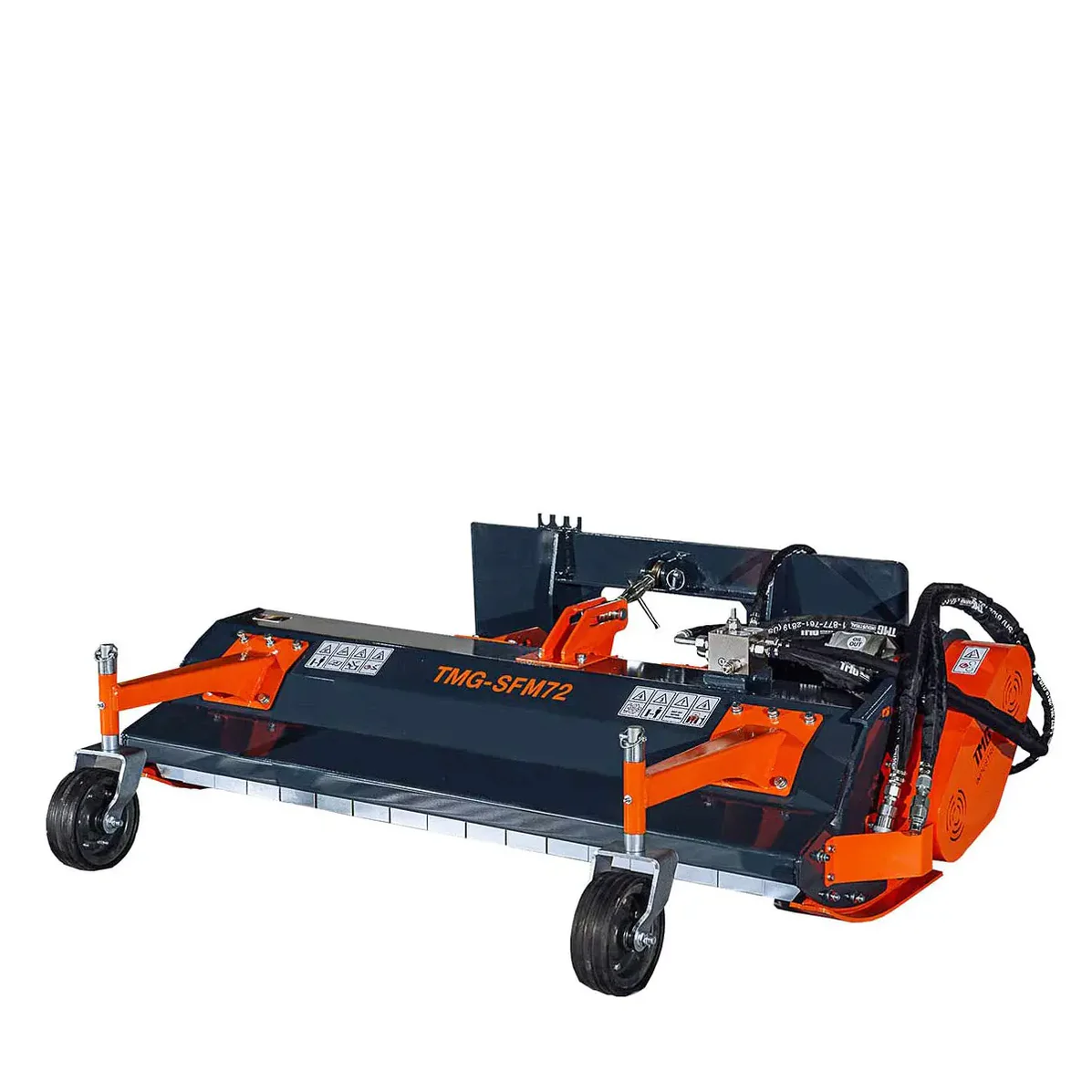
A 72 inch skid steer flail mower on a slope without compensation either digs its front edge into the bank or rides up over the growth. Both are corrected by the operator constantly adjusting tilt, which is fatiguing and inconsistent across a long shift.
Flail decks are less forgiving than rotary decks about angle
A rotary blade cuts on a single plane and tolerates a few degrees. A flail rotor cuts along its whole width with knives at the perimeter, so a tilted rotor presents different knives at different heights and the finish reflects that immediately.
Skid steer flail mower flow requirements decide whether it works at all
The rotor is driven by a hydraulic motor, so the specification is gallons per minute rather than horsepower. Below the stated range the rotor never reaches cutting speed and the machine tears growth rather than cutting it.
Standard and high flow are a fleet decision
Machines are built as one or the other, and retrofitting is rarely economic. That makes flow the first thing to establish before comparing attachments, since half the mowers on the market will not work on any given loader.
Standard flow and high flow are different machine configurations rather than settings. Fitting a high flow attachment to a standard flow loader produces a mower that turns and does not cut, which is the commonest mismatch on this class of equipment.
Case drain lines are the detail that destroys motors
Many hydraulic motors need a low pressure return directly to tank rather than through the working circuit. Running one without that connection builds pressure behind the motor seals, and the failure is expensive and entirely avoidable.
Oil temperature is the limit on a long day
Continuous mowing is sustained hydraulic work, and the carrier’s cooler was sized for intermittent attachment use. Late in a hot afternoon the oil climbs, flow falls, and an operator notices the machine cutting worse without anything obvious having changed.
Hinged knives are what let it work on rough ground
Flails swing back on contact rather than resisting, so a rock or a buried stump moves the knife instead of breaking the rotor. That tolerance is the reason this deck type is used on ground where a rotary mower would be destroyed.
Knife shape decides what the deck suits. Hammer style knives handle woody material and leave a coarse finish, while cup or scoop knives cut grass more cleanly and are less tolerant of anything solid, and swapping between them is a normal seasonal change.
Knives also wear as a set. Replacing a few and leaving the rest unbalances the rotor at working speed, which shows up as vibration through the loader arms long before anything visibly fails.
The rear roller sets the height and protects the ground
A full width roller carries the deck at a set distance above the surface and stops the knives from touching soil. It also flattens the cut material behind the machine, which is why a flail leaves a tidier finish than the same growth cut by a rotary deck.
Decks divide by how they are carried
•Three point mounted: tractor sets the reference
•Loader mounted: arm geometry changes the angle
•Boom mounted: reaches over, needs a large carrier
Where the loader mounted deck fits and where it does not
•Strength: reaches banks and ditches from level ground
•Strength: self leveling keeps the cut consistent
•Limit: flow range must match the carrier exactly
•Limit: sustained work heats the carrier’s oil
Weighed against a tractor mounted flail, the loader version costs hydraulic matching and returns access to ground a tractor should not be on. A municipal crew in New York specified the leveling kit after a season of banded cuts on roadside slopes.
Attachments are being specified by circuit rather than by size
Operators increasingly check flow range, case drain requirements, and leveling before comparing working width, having found that a well built attachment on a mismatched carrier performs worse than a modest one correctly paired.
That change in how attachments are chosen is why the machinery attachments TMG Industrial supplies state their circuit requirements alongside their cutting width.
