
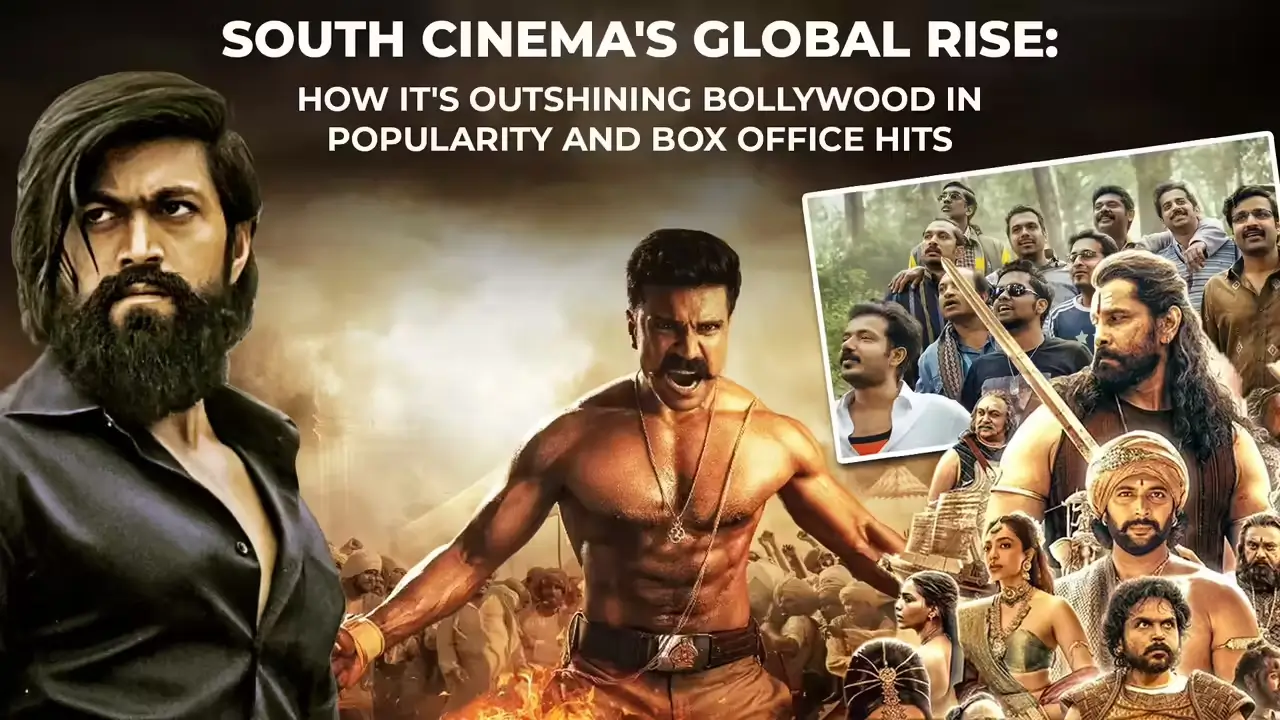
The numbers tell a story that would have seemed implausible a decade ago. In 2022, the year that RRR and KGF: Chapter 2 rewrote expectations for Indian cinema’s global reach, Telugu and Kannada films collectively generated more box office revenue than Hindi films in the domestic market for the first time in the post-Independence era. The following year maintained the pattern. The South Indian industry, Telugu, Tamil, Malayalam, and Kannada combined, has moved from regional prominence to national dominance in a period of less than five years, and the shift is not a temporary aberration driven by exceptional individual films. It is a structural change produced by a convergence of creative, technological, and market factors that Bollywood has been slow to understand and slower to respond to.
The Creative and Commercial Factors Behind the Shift
What South Indian Cinema Did Differently
The temptation to explain South Indian cinema’s commercial rise through the lens of individual exceptional films, RR, KGF, Pushpa, Baahubali, sees the underlying structural change that made those films possible and that continues to produce commercially successful films independently of any individual director or star. The exceptional films are the visible evidence of a systematic industry-level improvement in production quality, storytelling ambition, and audience understanding that has been building for over a decade.
Telugu and Tamil studios made a strategic decision in the early 2010s to invest in production values that competed with international standards rather than accepting the production quality differential with Hollywood as fixed. This decision was not simply about larger budgets; it was about building the technical infrastructure, crew capability, and post-production capacity that large budgets require to produce results. The visual effects work in Baahubali (2015) was not the product of a larger cheque written to an existing vendor; it was the product of years of investment in building domestic VFX capability that did not previously exist at that scale. The production quality that audiences experienced in that film was the visible output of infrastructure investment that had been accumulating invisibly for years.
The storytelling ambition that characterises the most successful South Indian films of the past decade reflects a different kind of investment: a willingness to commission and develop scripts that operate at a scale of narrative ambition historical epics, mythological frameworks, action sequences that require massive logistical coordination that Bollywood’s production model had moved away from in favour of the smaller-scale, star-driven contemporary dramas that had been commercially reliable in the 2000s. The audience that had been underserved by the retreat from large-scale filmmaking responded to its return with the enthusiasm that KGF and RRR demonstrated commercially.
The digital entertainment landscape has developed its own version of this audience segmentation insight, in the understanding that different audience segments respond to different scales and ambition levels in entertainment content, and that the segments served by large-scale, high-ambition entertainment are often larger and more commercially valuable than production economics had assumed.
A display of desiplay slots online catalogue that organises its titles by theme and volatility is applying the same principle: different player segments seek different engagement intensities, and the high-volatility titles, those with less frequent but larger reward events, serve a segment whose engagement pattern is analogous to the cinema audience that responds most strongly to large-scale, high-stakes narrative content. The entertainment economics that explain why high-ambition South Indian cinema found a large underserved audience are the same economics that explain why high-volatility, high-reward-potential content consistently finds audiences that moderate, predictable-reward content underserves.
The Pan-India Strategy and What It Requires
The explicit pan-India strategy adopted by major South Indian productions beginning with Baahubali represents a conscious decision to compete in the national market rather than accepting the linguistic segmentation that had previously limited South Indian films’ commercial ceiling. Executing this strategy required solving a set of distribution, dubbing, and marketing problems that the South Indian industry had not previously confronted at scale.
The dubbing quality investment was the most immediately visible component. South Indian films that were dubbed into Hindi had historically been identifiable as dubbed not simply through obvious lip-sync mismatches but through the register and naturalness of the Hindi dialogue, which reflected the priorities of a dubbing process oriented toward adequacy rather than excellence. The productions that succeeded in pan-India distribution in the current era invested in Hindi dubbing as a primary language version rather than as a secondary product, engaging dialogue writers and voice artists who could produce Hindi that sounded natural rather than translated.
The theatrical distribution expansion into Tier 2 and Tier 3 markets across Hindi-speaking states required relationships with distribution networks that South Indian producers had not previously built, and the commercial success of early pan-India releases created the commercial incentive for distributors in these markets to acquire South Indian films proactively rather than waiting to be approached. The distribution infrastructure that developed around the pan-India boom is itself a structural change, a network of relationships and commercial arrangements that exists independently of any individual film, a nd that reduces the friction for subsequent South Indian films entering these markets.
What Bollywood Must Understand and What It Has Got Wrong
The Misreading of the Situation and Its Consequences
Bollywood’s initial response to South Indian cinema’s commercial rise contained a misreading that has shaped and limited its subsequent strategic response. The misreading was to attribute the success of South Indian films to their scale and spectacle, which led to a series of expensive Hindi productions that attempted to compete on budget and visual effects without attending to the storytelling differences that made the South Indian films compelling rather than simply large.
The audience that responded to RRR was not responding primarily to its scale, though the scale was a necessary condition for realising the story’s ambitions. They were responding to the clarity and energy of its storytelling: protagonists with clearly defined motivations and relationships, a narrative that built toward a climax with genuine emotional stakes, and action sequences that expressed character rather than simply demonstrating technical capability. These are storytelling qualities, not production quality qualities, and they are not purchased by increasing the budget.
The structural storytelling differences between high-performing South Indian films and the Hindi productions that attempted to compete with them in the same period are identifiable and specific. South Indian films of this era consistently demonstrate a greater willingness to commit to a single emotional register across a film’s full runtime, a choice that risks alienating the multiplex audience that expects tonal variety, but that creates the emotional coherence that generates the word-of-mouth response that distinguishes a blockbuster from a successful opening weekend. Hindi productions of the same period frequently attempted tonal variety that compromised emotional coherence in ways that satisfied neither the multiplex audience fully nor the mass audience that responds most strongly to clear emotional commitment.
The characteristics of South Indian films that have achieved pan-India success that Bollywood’s strategic response has most consistently failed to replicate are:
- Protagonist clarity: the lead character’s motivation and moral framework are established with sufficient clarity that the audience’s identification with the character is unambiguous, which creates the emotional investment that makes the film’s resolution satisfying rather than simply spectacular
- Third act scale proportional to first act setup, the film’s climactic sequence delivers on the specific emotional and narrative promises made in its setup, rather than escalating to spectacular action that is disconnected from the character’s journey
- Cultural specificity as a strength rather than a constraint, the films that have crossed linguistic and cultural barriers most successfully are those that are most specifically rooted in their cultural context, not those that have attempted to be culturally neutral for a pan-India audience
The numbered actions that Bollywood producers and studios should take to compete more effectively with South Indian cinema’s current commercial and creative position are as follows:
- Commission story development independently of star attachment, allowing the story’s requirements to determine the casting rather than the star’s brand to determine the story. The South Indian films that have performed best pan-India have almost universally prioritised story over star, and the commercial results support this prioritisation.
- Invest in third act development with the same rigour applied to first act set-up. The most common structural failure in Hindi films attempting to compete with South Indian blockbusters is a climax that does not pay off the specific promises made in the first act, and this failure is a development problem, not a budget problem.m
- Build genuine dubbed versions rather than translated versions. The Hindi dubbing of South Indian films succeeds when it treats Hindi as a primary language version with its own appropriate dialogue register, and Bollywood’s international-language versions will succeed when they apply the same standard.
- Analyse audience response to South Indian films in Hindi-belt markets specifically, rather than in aggregate. Thee demographic and regional patterns of who responded to RRR, KGF, and Pushpa in markets outside their linguistic origin contain specific intelligence about which audience segments are underserved by current Hindi production and what they are responding to when they find something that serves them
Conclusion: This Is Structure, Not Cycle
The South Indian cinema boom is not a cycle that will reverse when Bollywood finds its footing or when South Indian producers make expensive failures. It is a structural reconfiguration of Indian cinema’s creative and commercial landscape produced by investment decisions, storytelling choices, and infrastructure development that took years to build and will take years more to displace. The Hindi film industry’s response to date has been to compete on the terms that South Indian cinema has already won scale, VFX, and theatrical spectacle rather than to identify and develop the storytelling capabilities that would allow it to compete on the terms that actually drive audience response. The industry that makes that strategic correction first will determine where Indian cinema goes over the next decade.
